The purchase only makes financial sense when saleable kilograms, not the extruder’s nameplate capacity, cover the installed cost and ongoing expenses. By the end, you will have a way to compare manual, semi-automatic and automatic lines, calculate payback, test the supplier’s output claim and check whether your Noida facility can support production.
Key takeaways
- Calculate payback from saleable kilograms, not nameplate capacity.
- Include dies, rejects, utilities, labour, finance, and distribution in machine cost.
- Match automation to confirmed orders, labour availability, and product range.
- Test output, moisture, power load, and service access before ordering.
When does an automatic macaroni machine justify its investment?
A search for an automatic macaroni machine for worth buying in noida should end with one calculation: saleable kilograms per day multiplied by your net contribution per kilogram. Use confirmed orders, not the extruder’s nameplate capacity. Subtract semolina, packaging, electricity, labour, maintenance, dies, rejects, finance and distribution costs before estimating payback.
The investment makes sense when demand keeps the complete line productive across your planned operating days and the output has a reliable sales route. Include the dryer, packing equipment and utilities in that test; a high-capacity extruder sitting behind an undersized dryer creates no additional saleable volume.
Check these decision points:
- Volume: calculate the kilograms you can sell each day after drying losses, changeovers, cleaning and rejects. Do not count unsold stock as utilisation.
- Labour: automation is valuable when skilled operators are scarce, manual handling causes errors, or one trained operator can replace several repetitive roles. You still need someone to control hydration, dies, dryer settings, moisture and sanitation.
- Payback: set a maximum target of 24 to 36 months, then test the result against lower sales, higher semolina costs and one major repair. Reject the purchase if the slower case breaks cash flow.
The automatic macaroni machine benefits are repeatable feeding and cutting, reduced handling, easier continuous-dryer integration and stronger production records. Those benefits justify the capital only when margin and confirmed demand pay for them.
What should you include in the real macaroni production machine cost?
Break-even must include the complete installed line, not just the quoted extruder. Your macaroni production machine cost factors include capacity, dryer configuration, vacuum extrusion, die count, stainless-steel construction, controls and packing integration.
| Cost block | Include | Break-even treatment |
|---|---|---|
| Purchase | Mixer, extruder, cutter, dryer, cooler, conveyors, compressor, packing equipment, dies, taxes, freight and spare parts | Add the full delivered equipment cost |
| Installation | Electrical cabling, panels, load upgrades, water treatment, drainage, ventilation, heat removal, commissioning and operator training | Add before calculating the investment |
| Operating | Semolina, packaging, electricity, labour, cleaning, maintenance, rejects, distribution and replacement dies | Subtract from the selling price per saleable kilogram |
| Financing | Interest, processing charges, insurance and repayment fees | Add the actual monthly financing cost to fixed outgoings |
Treat dies as recurring costs. Shape, diameter, wall thickness and cut length depend on the die and cutter; each change consumes cleaning and setup time, so record replacement price, material and lead time.
A dryer can require extra electrical capacity and ventilation in Noida. Include the cost of managing heat, humidity, condensation and worker comfort, rather than treating the dryer as a free addition to the room.
Calculate using saleable kilograms per day, not nameplate kilograms per hour. Divide total fixed costs by the contribution per saleable kilogram after ingredients, packaging, labour, power, maintenance, rejects, finance and distribution; this gives the volume required to break even.
Which level of automation and line configuration fits your business?
A startup or restaurant supplier rarely needs a full continuous line on day one. Choose the smallest setup that meets confirmed orders, leaves room for sanitation and drying, and does not leave expensive equipment idle.
| Option | Labour and consistency | Best fit | Line configuration |
|---|---|---|---|
| Manual | Highest operator input, slower changeovers, and greater variation in feeding, cutting and shape | Startups testing recipes or local restaurant supply | Mixer, extruder and cutter, with separate trays or racks for drying |
| Semi-automatic | One operator controls feeding, cutting and transfers; output is steadier without full integration | Small factories and contract manufacturers with several recipes or moderate volumes | Extruder and cutter plus assisted conveyors, pre-dryer or dryer, and separate packing |
| Fully automatic | Lowest manual handling, repeatable feeding and cutting, continuous drying, and stronger production records | Packaged-food plants and contract manufacturers with stable, high-volume orders | Mixer, vacuum extruder, cutter, pre-dryer, main dryer, cooler, conveyors, weighing and packing |
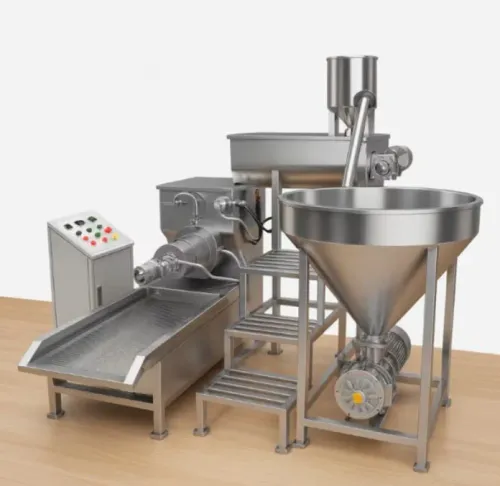
A commercial macaroni machine for business is not automatically a complete factory. Confirm whether the quotation includes the dryer, cooler, compressor, water treatment, electrical installation, conveyors, dies and packing equipment; many cover only the mixer, extruder and cutter.
The automatic macaroni machine benefits matter only when operators still control hydration, die wear, dryer temperature, product moisture and sanitation. Automation does not replace an FSSAI-compliant layout, cleanable food-contact surfaces or documented cleaning.
For a growing small factory, semi-automatic equipment often protects cash flow better than a fully integrated line. Move to full automation when daily orders support continuous running and your team can keep the dryer and packing section supplied.
Why does quoted hourly capacity differ from saleable output?
A quoted 500 kg per hour usually describes extrusion under fixed conditions, not packed product ready for dispatch. Your saleable figure falls when the formulation needs slower drying, a small elbow die runs below the stated rate, or the packing line cannot keep up.
| Output factor | What reduces kilograms you can sell | What to verify |
|---|---|---|
| Formulation and die tooling | Water level, semolina quality, shape, diameter and cutting speed alter throughput; small shells and elbows often need slower settings | Trial your formulation with the exact die |
| Drying and cooling | Insufficient dryer residence time creates excess moisture, cracking or product sticking; an oversized extruder then waits for the dryer | Match dryer capacity, target moisture and ambient conditions |
| Rejects and start-up waste | Misshapen pieces, broken macaroni, off-spec moisture and contaminated batches leave the saleable total | Weigh rejects during a full production trial |
| Cleaning and changeovers | Sanitation, die removal, dough purging and product changes stop production instead of making kilograms | Record minutes lost per shift |
| Packing | Weighing errors, seal failures, film changes and manual packing create finished-goods losses | Test the actual pack size and packing speed |
Calculate saleable output as running hours multiplied by tested hourly rate, then subtract rejects and pack losses. Deduct cleaning and changeover time before multiplying by operating days.
The automatic macaroni machine benefits include repeatable feeding and cutting, but automation does not remove these constraints. A commercial macaroni machine for business is viable only when its extruder, dryer and packing equipment deliver enough saleable kilograms to cover semolina, labour, energy, maintenance and distribution.
How should you validate a Noida installation before placing the order?
Do not approve the quotation until the Noida site and the complete installed scope pass inspection. A commercial macaroni machine for business may include only the mixer, extruder and cutter, leaving you to arrange the dryer, cooler, conveyors, packing line, compressor, water treatment and electrical work.
Include these macaroni production machine cost factors before comparing suppliers.
1. Measure the production room, doorways and service clearances. Confirm three-phase power, connected load, earthing, water pressure and tested water quality; specify drainage, floor slope, ventilation and heat removal for the dryer.
2. Map separate areas for semolina storage, dough preparation, drying, finished product and packaging. Require washable walls, cleanable floors, pest control, hand-washing facilities, covered drains and protection against condensation. Check the proposed layout against FSSAI licensing, hygiene, cleaning, storage, water and record-keeping obligations before construction.
3. Define the supply boundary in writing. List the mixer, vacuum system, dies, cutter, pre-dryer, main dryer, cooler, control panel, compressor, conveyors, packing interface, installation, freight, taxes, spare parts, training and commissioning. Shan Engineerings Works, or another supplier, should identify every excluded item and provide utility drawings.
4. Run a factory acceptance test using your semolina, recipe, die and target shape. Record saleable kilograms per hour, product moisture, breakage, shape, rejects, dryer performance, electrical consumption, changeover time, noise and safety faults.
Make payment conditional on a signed site-acceptance test and agreed remedies: corrective work, replacement parts, response times, warranty coverage and operator training. Ensure the supplier supplies manuals, wiring diagrams, cleaning instructions, spare-parts lists and calibration records.
Related products
 | Pasta Making Machine Automatic Macroni Making Machine Our Automatic Macaroni Making Machine is a fully stainless-steel, industrial-grade pasta processing machine designed to deliver continuous,... View product → |
 | Pasta Making Machine The Macroni Making Machine from SHAN ENGINEERINGS WORKS is a high-efficiency, fully automatic pasta production solution designed for small to... View product → |
Frequently asked questions
When does an automatic macaroni machine justify its investment?
It can justify investment when confirmed demand supports consistent saleable output and your net contribution per kilogram gives an acceptable payback period. Calculate using actual orders, not the extruder’s rated capacity.
What should be included in macaroni production machine cost?
Include the machine and installation, dies, semolina, packaging, electricity, labour, maintenance, rejects, finance, distribution, utilities, spare parts, and commissioning costs.
Which automation level fits a macaroni business?
Choose automation based on confirmed volume, available labour, product variety, packaging needs, and budget. A modular line can suit a growing business better than a fully automated line sized for unproven demand.
Why does quoted hourly capacity differ from saleable output?
Quoted capacity often describes ideal extruder throughput. Saleable output falls after changeovers, drying limits, moisture variation, rejects, downtime, cleaning, packaging losses, and quality holds.
How should you validate a Noida installation before ordering?
Check the factory layout, electrical load, water and compressed-air requirements, ventilation, drainage, operator access, food-contact materials, installation scope, spare-parts support, and a witnessed production test.
Related products
 | Noodle Making Machine The Noodle Making Machine by SHAN ENGINEERINGS WORKS is a high-performance, fully automatic machine designed to produce instant noodles, Hakka... View product → |
 | Pasta Making Machine A pasta-making machine is a device that automates the process of mixing, kneading, and shaping dough into various types of fresh pasta. View product → |
Keywords