Choosing a noodle line starts with the product route, not the machine name. By the end, you will be able to match instant, Hakka, cup, institutional, and fresh-noodle production with the right modules, utilities, plant scale, hygiene controls, and service terms.
Key takeaways
- Match the line to noodle type, cooking method, pack format, and daily demand.
- Specify mixers, sheeters, cutters, steamers, dryers, and packing interfaces as one process.
- Size electrical load, steam, water, compressed air, drainage, and floor space together.
- Require ingredient trials, hygiene records, acceptance tests, and local service response times.
Which commercial noodle applications suit a Noida food plant?
Start with the product, shelf life, pack format, cooking method, and daily demand—not the machine brand. The main noodle machine applications in Noida fall into five distinct commercial routes:
| Application | Process and pack | Best fit |
|---|---|---|
| Fried instant noodles | Steam, cut into blocks, fry, cool, and pack with seasoning sachets | Long shelf-life retail products |
| Non-fried instant noodles | Steam, cut, and dry with hot air before packing | Lower-fat instant products |
| Hakka or other sheeted noodles | Roll dough through reduction rolls, slit the sheet, then supply fresh or dried | Retail, foodservice, and wholesale noodles |
| Cup noodles | Portion noodle cakes, fill cups, add seasoning, seal lids, and code dates | Single-serve convenience products |
| Fresh packaged noodles | Produce, portion, seal, and refrigerate for restaurants, caterers, hotels, schools, and institutional kitchens | Short shelf-life supply contracts |
Sheeted and extruded routes are not interchangeable. Sheeted dough passes through rolls before slitting; extruded dough is forced through a die. They therefore need different moisture control, tooling, texture trials, and changeover procedures.
A central food-plant line suits higher demand because it adds sanitation zoning, continuous conveying, automated weighing, thermal processing, packaging integration, and documented cleaning. A compact restaurant or retail-kitchen machine is better when volumes, formats, and distribution distances remain small. These industrial noodle machine uses should define the quotation.
What modules and process sequence does each noodle line require?
1. Start every line with a flour or premix dosing system, water and alkaline-salt dosing, a dough mixer, kneader, and resting section. The mixer must deliver consistent hydration; inadequate resting causes uneven sheeting, extrusion pressure, and texture.
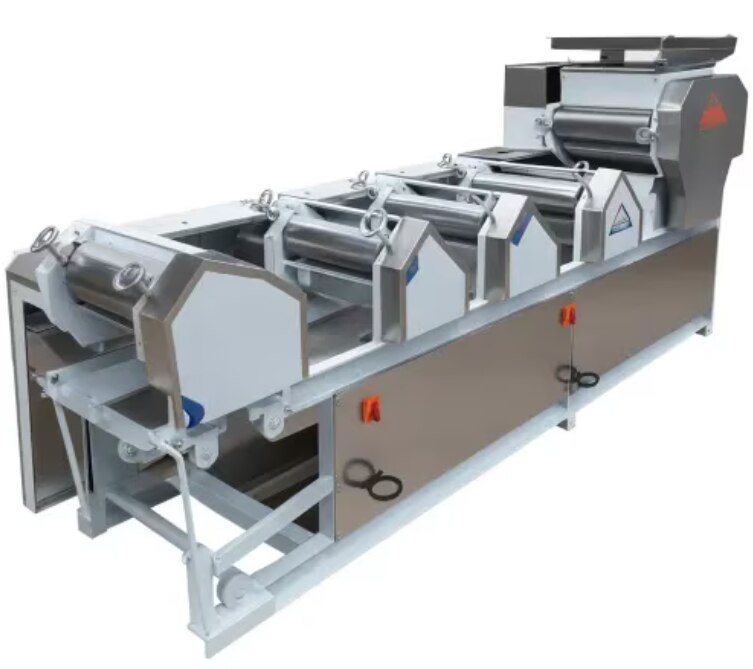
2. For Hakka and other sheeted noodles, pass rested dough through a roll sheeter, then a noodle cutter for slitting and length control. A noodle machine for food processing plant using this route needs roll-gap adjustment and cutters matched to each width and thickness.
3. For extruded formats, replace the sheeter with an extruder and product-specific die tooling. Confirm moisture range, die pressure, strand shape, and tooling changeover before accepting a claimed capacity.
4. For instant noodles, steam the formed noodles, cut and portion them, then choose the finish: a fryer with oil filtration, crumb removal, oil-level and temperature control for fried cakes, or a multi-zone dryer with exhaust and humidity control for non-fried cakes. Both routes need cooling conveyors before seasoning and packing.
5. Match final equipment to the pack: a seasoning system and pillow-pack machine for wrapped cakes; a cup filler, sachet inserter, lid sealer, and date coder for cup noodles. Fresh products may need portioning and pillow packing without steaming, frying, or drying.
6. Require every quotation to state flour throughput in kilograms per hour and finished packs per minute, with cake weight, lane count, rejected-pack allowance, and changeover time. Compare complete line balance and saleable yield, not the advertised cutter or extruder alone.
How should you size the line, utilities, and factory layout?
Size the line from saleable output, staffing, changeover time, and cleaning access—not motor rating. A line that reaches its nameplate rate but loses hours between recipes or requires excessive manual cleaning is undersized for the plant’s actual schedule.
| Option | Practical output | Staffing, changeover, and cleaning |
|---|---|---|
| Pilot or small semi-automatic | 50–150 kg/h | More operators handle feeding, transfers, packing, and inspection; changeovers are quicker, but manual dismantling increases cleaning time. |
| Mid-scale semi-automatic | 200–600 kg/h | Fewer operators per kilogram, with moderate changeover work; conveyors, steamer, fryer or dryer, and packing equipment add cleaning points. |
| Large continuous | 800–2,000 kg/h | Lowest labour per kilogram during stable production, but longer changeovers, sanitation downtime, and higher consequences from one blocked or contaminated section. |
Confirm these trial figures: noodle width around 0.8–2.0 mm, thickness around 0.6–1.5 mm, steaming at about 95–100°C for 1–3 minutes, frying at 140–160°C for 60–120 seconds, and staged hot-air drying at 60–90°C for roughly 20–45 minutes. Formulation determines the final settings, so validate every figure with the intended recipe.
Freeze a utility schedule before ordering. Request electrical load, steam or thermal-oil demand, water use, compressed-air pressure and flow, exhaust capacity, cooling requirements, and floor-space drawings.
Design separate raw, wet-process, thermal, cooling, packing, and dispatch zones. Noida’s monsoon humidity requires seasonal inlet-air data, conditioned make-up air, dryer-exhaust handling, insulation, and condensation controls. Provide drainage and cleaning access without operators reaching over exposed noodles.
Which ingredients, hygiene controls, and acceptance tests protect product quality?
Freeze the formulation before choosing rolls, cutters, dies, or fryer capacity. Set flour protein, such as 11–13% for many noodle recipes, dough moisture, often 30–34%, and dough temperature, commonly 25–30°C, through trials. For alkaline noodles, name sodium carbonate, potassium carbonate, or kansui and state the dose as a percentage of flour.
For fried noodles, specify oil type, filtration, crumb removal, oil level, temperature uniformity, turnover, and degradation monitoring.
| Formulation change | Process effect | Quality risk |
|---|---|---|
| Higher hydration | Softer slitting; lower extrusion pressure; longer drying | Sticky strands and soft cooking texture |
| Lower hydration | Harder slitting; higher extrusion pressure; shorter drying | Breakage and firm, undercooked texture |
| Uneven hydration | Irregular strand size and pressure | Variable cooking and cake weight |
Control drying with air temperature, relative humidity, velocity, product loading, residence time, and final moisture together. Excessive surface drying creates case-hardening: a dry shell traps moisture inside. Insufficient drying threatens shelf life through excess moisture and microbial growth.
Specify 304 stainless steel for ordinary product-contact zones and 316 where salt, cleaning chemicals, or corrosive exposure justify it. Require smooth welds, drainable surfaces, removable guards, protected bearings, accessible seals, no flour traps, controlled lubrication, and written allergen-changeover instructions.
Run acceptance trials using the buyer’s flour, recipe, noodle dimensions, packaging, and planned speed. Record:
- Throughput, final moisture, cooking loss, cake or strand breakage, weight variation, oil uptake, utility consumption, and saleable yield.
What should you require from a noodle-machine supplier in Noida?
Require a complete noodle-production project, not a cutter or extruder with a capacity claim. Compare the full line balance from dosing and mixing through forming, steaming, frying or drying, cooling, seasoning, and packing.
| Supplier evidence | What to compare |
|---|---|
| Complete-line proposal | Kilograms per hour, packs per minute, saleable yield, rejected packs, and bottleneck equipment |
| Factory demonstration | Actual changeover duration, cleaning access, recipe repeatability, and utility consumption |
| Support package | Installation, commissioning, operator training, recipe support, preventive-maintenance intervals, critical spares, and PLC and electrical backups |
| Handover documents | Drawings, manuals, software backups, maintenance schedules, and acceptance-test records |
For noodle machine service in Noida, require a named local contact, local-stock confirmation for critical spares, a remote-diagnostics process, response and escalation times, and a written allocation of responsibility for commissioning defects. “Pan-India service” does not prove rapid intervention or parts held in Noida.
A buyer evaluating Shan Engineerings Works should request trials using the planned flour, noodle dimensions, pack format, and operating speed, then compare documented throughput, moisture, cooking loss, breakage, weight variation, oil uptake, utility consumption, and saleable yield with competing quotations. Freeze the electrical, water, compressed-air, steam or thermal-oil, exhaust, cooling, and floor-space schedule before ordering.
Separately verify the actual plant’s food-business licensing, boiler and pressure-system obligations, wastewater controls, hygiene controls, and Uttar Pradesh consent conditions. A food-grade machine does not settle those approvals.
Related product
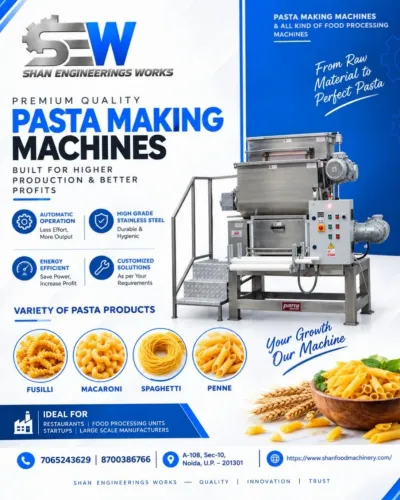
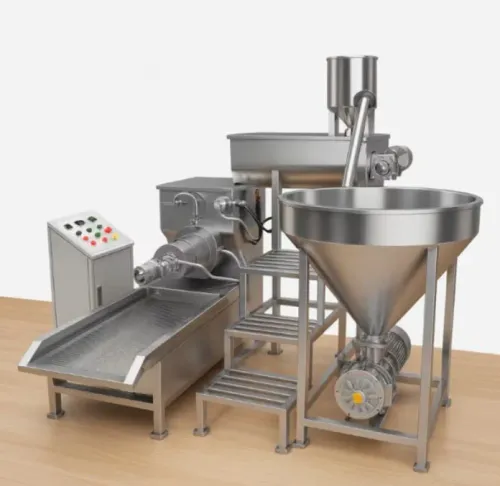
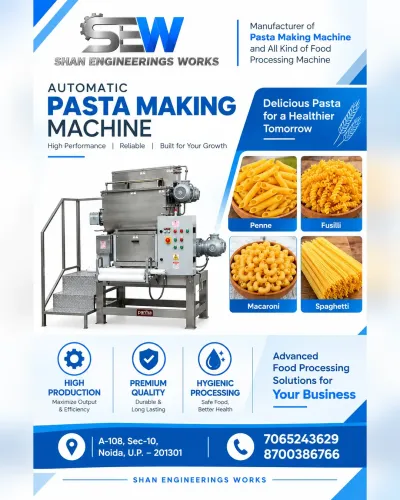
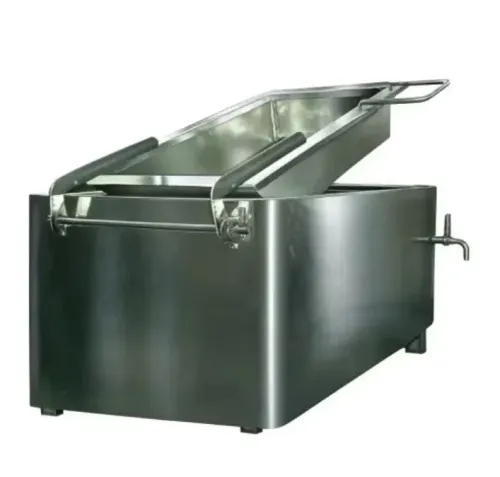
 | Noodle Making Machine The Noodle Making Machine by SHAN ENGINEERINGS WORKS is a high-performance, fully automatic machine designed to produce instant noodles, Hakka... View product → |
Frequently asked questions
Which commercial noodle applications suit a Noida food plant?
Choose among fresh noodles, dried wheat noodles, instant fried noodles, instant non-fried noodles, and specialty or extruded noodles based on the product, shelf life, cooking method, pack format, and daily demand.
What modules and process sequence does each noodle line require?
A line can include ingredient dosing, mixing, resting, sheeting, compounding, slitting, steaming, cutting, portioning, frying or hot-air drying, cooling, inspection, and packing. The required sequence depends on the noodle route.
How should you size a noodle line, utilities, and factory layout?
Start with saleable kilograms per day, operating hours, line yield, changeover time, and pack weight. Then calculate equipment capacity, electrical load, steam, water, compressed air, drainage, ventilation, access, and maintenance space.
Which ingredients, hygiene controls, and acceptance tests protect noodle quality?
Control flour or semolina specifications, water quality, salt and alkaline-salt dosing, dough moisture, sheet thickness, noodle dimensions, cooking loss, texture, microbial results, foreign-body risks, cleanability, and documented factory acceptance tests.
What should you require from a noodle-machine supplier in Noida?
Request a process guarantee, equipment layout, utility schedule, food-contact material details, cleaning instructions, spare-parts list, operator training, commissioning scope, acceptance criteria, warranty terms, and defined noodle machine service response times in Noida.
Keywords