Sticky dough, uneven strands, repeated line trips, excess oil uptake, and wet noodle centres do not all point to a failed machine. By tracing the defect through mixing, forming, cutting, thermal processing, cooling, and packing, you can separate recipe and climate effects from mechanical faults, protect affected batches, and give a repair technician usable evidence.
Key takeaways
- Retain samples from each stage to locate where the defect first appears.
- Correct dough moisture, sheet thickness, die clearance, and cutting speed before replacing parts.
- Check steam, frying, drying, cooling, and packing conditions against recorded settings.
- Give repair technicians fault codes, photos, measurements, and recent maintenance history.
Start with the symptom and isolate the process stage
A defect begins at the first stage where a retained sample fails, not necessarily where you notice it. Sticky dough points to mixing or resting; uneven thickness to rollers or extrusion; broken strands and blocked dies to dough condition, die clearance, or feed pressure; irregular cutting to sheet tension, knife, comb, or speed.
1. Hold the flour lot, water temperature, recipe, and line speed constant. Change one mechanical setting at a time, then retain samples from mixing, sheeting or extrusion, cutting, drying or frying, and final packing.
2. Measure flour moisture, dough moisture, dough temperature, room relative humidity, and finished-noodle moisture for each batch. Monsoon humidity in Noida can create adhesion, slow drying, and poor crispness without a mechanical failure.
3. Check flour temperature, water temperature, mixing time, salt or alkali concentration, and actual dough moisture before adding water. Many wheat-noodle processes use about 30–35% water against flour weight, but overhydration can cause tearing and sticking.
4. Record roller or die gap, cutter speed, sheet feed speed, steam or frying condition, and the exact sample location. A cutter running faster than the sheet feed can create short pieces, overlapping strands, and uncut webs.
For noodle machine troubleshooting, compare the first failed sample with the last acceptable one. This evidence separates recipe, material, operator, and stage-specific faults from genuine noodle machine problems in Noida, where changing several settings at once can hide the cause.
Fix dough, sheet, die, and cutting defects before replacing parts
Sticky dough in monsoon conditions often reflects flour moisture, room humidity, or dough temperature rather than a failed component. Record flour moisture, dough moisture, dough temperature, room relative humidity, water addition, mixing time, and resting time before changing the recipe.
| Symptom | Operating checks | Likely correction |
|---|---|---|
| Sticky dough | Check moisture, temperature, mixing, resting, and sheet adhesion | Adjust water only after recording flour and room conditions; extend resting time if needed |
| Uneven thickness | Check roll parallelism with feeler gauges, roll wear, gap, alignment, and centred feed | Reset the roll gap or align the rolls; replace worn rolls only after measurement |
| Broken strands | Inspect dough conditioning, die holes, die blockage, sheet tension, and line speed | Correct hydration or resting, clear the die, and synchronise feed and cutter speeds |
| Blocked die | Stop the feed; inspect screens, dough lumps, die-hole wear, and dough temperature | Clean the die safely and correct upstream dough consistency |
| Low output | Check feed rate, roll or die gap, blockage, belt speed, and speed matching | Remove restrictions and balance speeds before changing drives |
| Irregular cutting | Check knife sharpness, knife-to-comb clearance, comb condition, sheet tension, and thickness | Set the cutter to the sheet feed speed; do not increase cutter speed alone |
These checks address common noodle production issues and noodle manufacturing problems. Run a controlled trial with the same flour lot, water temperature, recipe, and line speed; change one mechanical setting at a time and retain samples after mixing, sheeting, cutting, and final packing.
This exposes the first failure instead of masking it with a replacement part.
Control steaming, frying, drying, cooling, and packing conditions
A dry-looking surface does not prove a dry noodle. Internal moisture can release steam during frying, increase oil uptake, distort the block, and leave noodles sticky after cooling.
- Steaming: Check steam pressure, temperature, residence time, and feed density. Incomplete steaming leaves a wet centre; excessive steaming softens the block and increases deformation.
- Frying: Hold oil temperature and belt speed steady. Check dough-sheet thickness, noodle-block density, frying time, filtration, oil turnover, free-fatty-acid level, and total polar compounds. Low temperature, short frying, or excess internal moisture drives oil absorption.
- Drying: For under-drying, reduce belt speed or increase drying-air temperature or airflow within your product specification. For over-drying, reverse that adjustment; do not compensate by adding water during packing.
- Colour: Verify alkaline-salt dosing by weighing and confirm pH with a calibrated meter. Excess alkali darkens noodles and creates a harsh taste; a blocked dosing line can produce the opposite symptom.
- Cooling and packing: Cool fried noodles until the centre and surface are stable before packing. Residual heat creates condensation inside the pack, while surface oil and moisture encourage noodles to stick.
For noodle machine troubleshooting, run a controlled trial with the same flour lot, recipe, water temperature, and line speed. Change one setting at a time and retain samples after steaming, frying, cooling, and packing.
Record flour moisture, room humidity, dough temperature, finished-noodle moisture, oil temperature, and belt speed; seasonal humidity in Noida can create noodle production issues that resemble equipment faults.
Separate mechanical, electrical, water, and maintenance faults from process errors
Hold the flour lot, water temperature, recipe, and line speed constant before changing anything. Retain samples after mixing, sheeting or extrusion, cutting, drying or frying, and packing; final packs alone cannot locate noodle manufacturing problems.
This controlled trial is essential when investigating noodle machine problems in Noida, where ambient heat, dust, and operator changes can resemble equipment failure.
1. Adjust recipe or speed when the machine runs smoothly and the defect follows dough condition or throughput. Check flour and dough moisture, water temperature, mixing and resting time, salt or alkali concentration, roller or die gap, and cutter speed.
For wheat noodles, do not add water simply because dough looks dry; excessive surface moisture causes sticking and tearing.
2. Stop the line when noise, vibration, rising torque, repeated overloads, strand rubbing, or irregular motion appears. Inspect drives, gearboxes, bearings, belts, rolls, cutters, and fasteners for wear, misalignment, jamming, or overheating. Record motor current on each phase and the drive fault code before resetting an overload.
3. Treat heating, sensing, and utilities as separate faults. Check heaters, temperature sensors, steam controls, and blocked screens when process temperatures drift. Measure phase-to-phase voltage under load, inspect loose terminals and panel cooling, and clean dusty filters.
Verify water filtration, hardness treatment, and dosing when scale or unstable dough appears; lubricate only with the specified product, quantity, and interval, never by mixing similar-looking greases.
Prepare a safe repair call and preventive-maintenance plan in Noida
Quarantine noodles made since the last verified good check, plus flour, dough, oil, and packaging exposed to the suspected fault. Tag the affected lot and do not release it after a short clean run; hidden residue, metal fragments, lubricant, or moisture damage can remain.
- Stop the line, isolate electrical and pneumatic energy, and record the machine state before adjustment. Photograph the cutter, die, belts, sensors, alarms, and control-panel values.
- Clean food-contact surfaces, dies, rollers, cutter guards, belts, and product traps. Inspect seals, frame openings, fasteners, corrosion, and lubricant leaks; keep maintenance chemicals away from food-contact tools.
- Record the batch and flour lot, flour and dough moisture, room relative humidity, dough temperature, line speed, roller or die gap, steam or frying temperature, drying conditions, and the first stage where the defect appeared.
- Stock failure-critical parts: knives, combs, belts, chains, food-grade seals, standard bearings, thermocouples, proximity sensors, VFD fans, contactors or solid-state relays, and machine-specific drives. Match installed part numbers, voltage, signal, temperature, and ingress-protection ratings.
- Tell the provider the symptom, affected batch, photographs, alarm codes, recent adjustments, cleaning status, lubricant specification and quantity, bearing temperature, and maintenance history. Do not approve cutter replacement before knife-to-comb clearance, sharpness, comb condition, sheet tension, and thickness are documented.
For noodle machine repair in Noida, request checks for monsoon moisture, water quality, power quality, lubrication contamination, and sanitation access. Shan Engineerings Works can use those records to distinguish noodle machine problems in Noida from recipe or operator changes.
Schedule inspections by running hours and log every bearing, gearbox, lubricant, interval, and temperature; never mix greases by appearance alone.
Related product
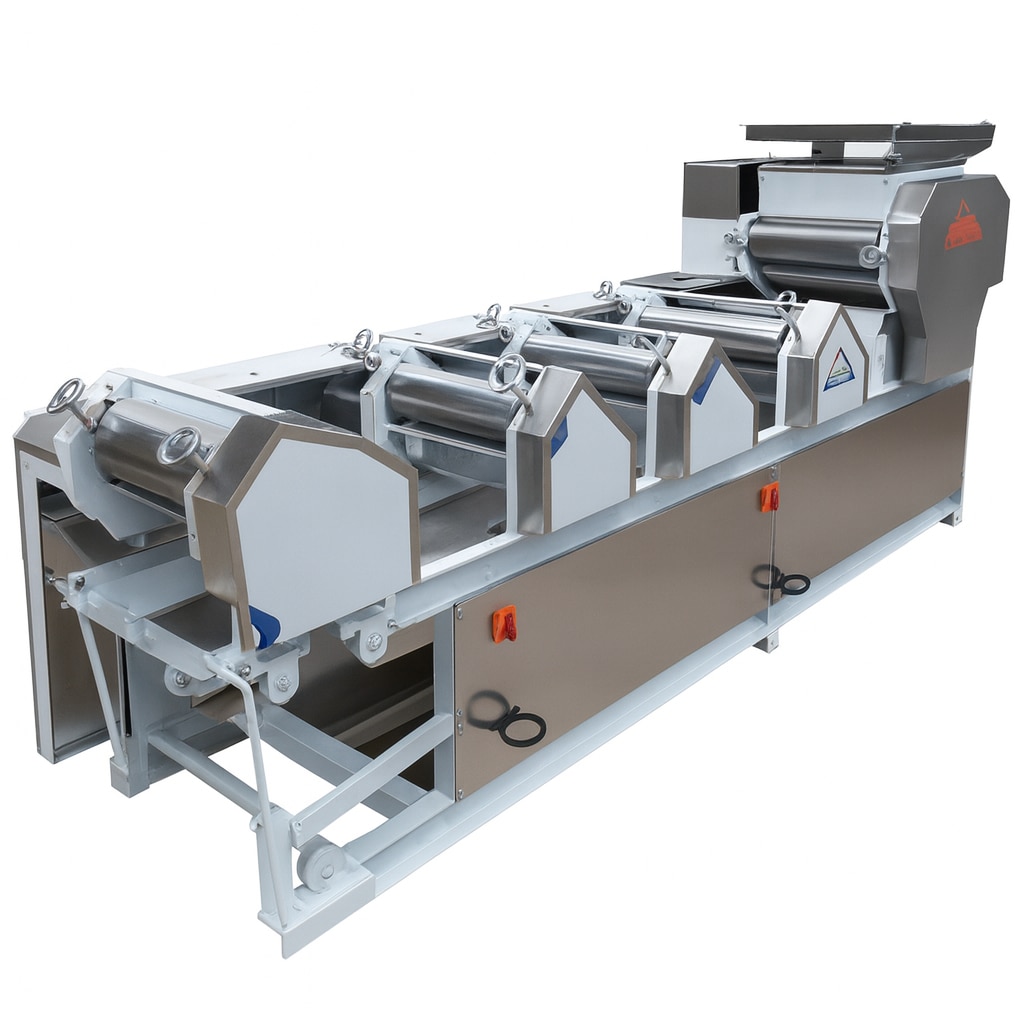 | Noodle Making Machine The Noodle Making Machine by SHAN ENGINEERINGS WORKS is a high-performance, fully automatic machine designed to produce instant noodles, Hakka... View product → |
Frequently asked questions
How do you identify the source of a noodle production defect?
Compare retained samples after mixing, resting, sheeting or extrusion, cutting, steaming, frying, drying, cooling, and packing. The first failed sample identifies the process stage to investigate.
What should you check before replacing a noodle machine part?
Check dough moisture and resting time, roller gap, die clearance, feed pressure, sheet tension, knife or comb alignment, and line speed before changing components.
Which conditions affect steamed, fried, dried, and packed noodles?
Check steam temperature and distribution, frying temperature and residence time, dryer temperature and airflow, cooling time, product moisture, sealing temperature, and pack integrity.
What information should you provide for noodle machine repair in Noida?
Provide the machine model and serial number, fault codes, affected product and batch, retained samples, photos or video, measured settings, electrical readings, water details, and maintenance history.
Keywords